
A Shift Handover Example: 24 Hours, Three Shifts, One Machine Shop
Imagine one machine shop, three shifts, 24 hours: a shift handover example, from the 5:50 AM clock-in to the 2:40 AM fix on the saw.
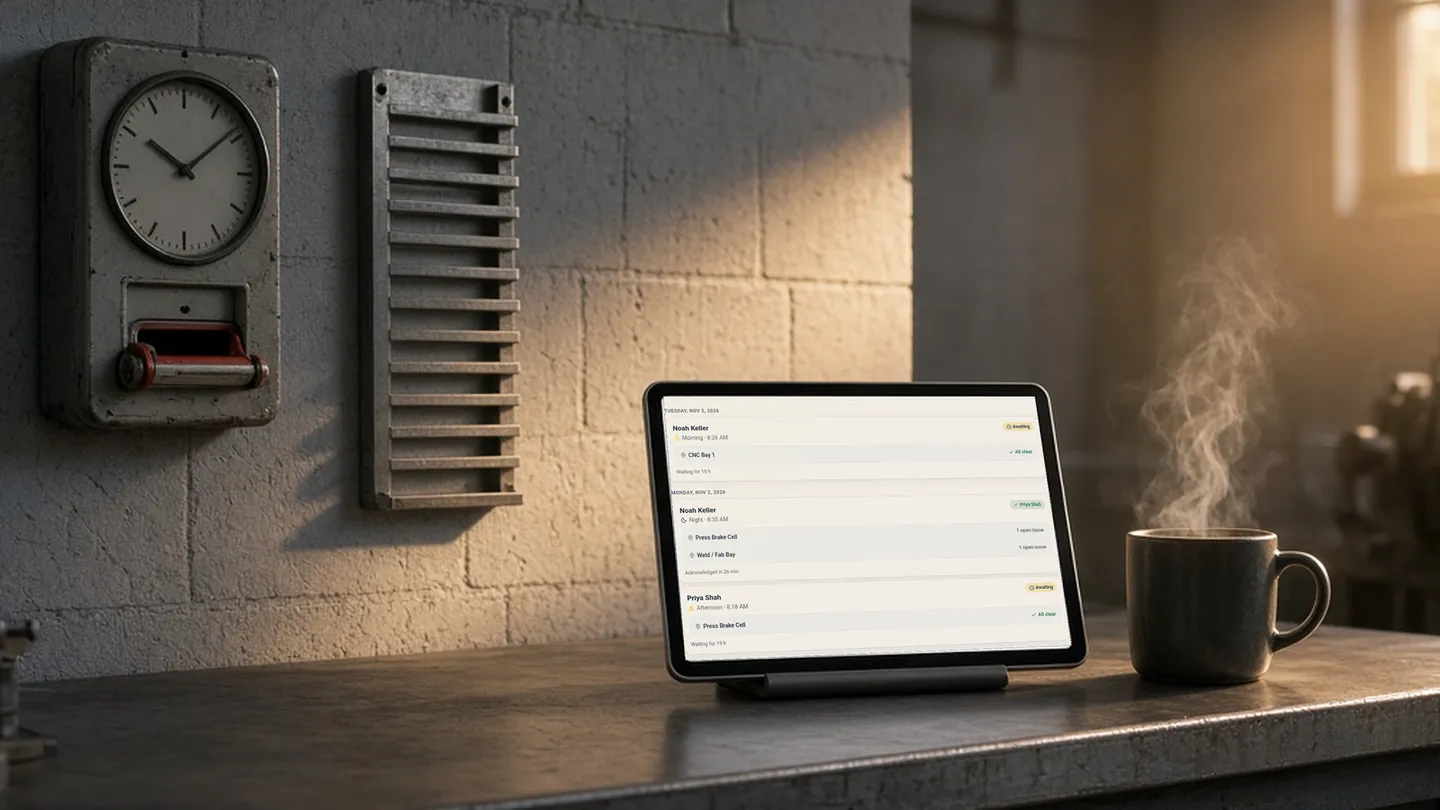
Imagine a machine shop. You've probably worked in one just like it: about 80 people, three shifts, a row of CNC machines, a fabrication corner with a press brake and a saw, and a kettle that has outlived three plant managers. Follow it for 24 hours and you get a shift handover example that shows every job a handover (in US plants, a passdown) has to do, and what each shift change looks like when the handover lives in ShiftPanda.
Hilary runs days. Rhys runs lates. Neville runs nights. Philippa is the plant manager, and Alf is the maintenance fitter who knows every machine by the noise it makes.
5:50 AM: The night-to-day handover
Hilary clocks in. Her coffee is still too hot to drink, which is fine, because Neville's handover is already sent and she reads it on her phone, standing next to the time clock.
It's laid out the same way every morning: area by area, machine by machine.
Machining, Lathe 2: Running. Bracket job done. 40 left on the shaft order, program's loaded. Machining, HMC 3: Idle. Coolant leaking at the base. Photo attached. Alf knows. Fabrication, Press Brake 1: Running. Fine. Actually fine.
The photo does a lot of the work. "Leaking at the base" could mean a drip or a lake. The photo says drip, with a square of cardboard under it that someone has labelled DO NOT MOVE.
Hilary acknowledges the handover, and her name shows on it. Neville gets to go home without the five-minute debrief in the car park.
The use case: a handover written by area and machine, with status, notes and photos, so the incoming supervisor's first ten minutes go on reading, not detective work.
7:45 AM: The plant manager reads the handovers
Philippa has the production meeting at 8:00 AM. She doesn't text anyone to ask how the night went. She's an Admin, so she opens the night's handover from her desk, sees HMC 3 sitting on the Open Issues list, and sees that Hilary has read and acknowledged it.
So the meeting starts at "HMC 3 is waiting on Alf" instead of "so, what happened last night?" The time goes on deciding, not on rebuilding the night, and nobody has to book a meeting about the meeting. There's more on this in how plant managers use the overnight handover.
The use case: the plant manager reads what happened on every shift without walking the floor to collect it.
10:20 AM: An issue that won't wait for the handover
Callum, a crew member in Fabrication, walks over holding a part. The saw is wandering on its cuts. Not by much. Just enough to make the next operation miserable.
On a lot of floors, this is where the note goes on the back of a hand, on a sticky note on a monitor or into the memory of someone who will be very busy for the next three hours. Hilary logs it as an issue instead, against Fabrication and the saw, with a photo of the crooked cut. It goes straight onto the Open Issues list.
Logging it takes less time than the argument about whether it's the blade or the vice.
The use case: issues logged mid-shift by area and machine, so they don't depend on someone remembering them at 2:00 PM.
1:55 PM: The day-to-lates handover
Hilary writes her handover. A simple one takes about a minute. Today's isn't simple, so it takes under two.
She doesn't retype the saw. It's already there, carried over from the Open Issues list, along with HMC 3. She adds that the blade has been swapped and the cuts are still off.
Halfway through, the Wi-Fi drops. It always does in the back corner by the press brake, where a steel rack eats the signal. When it comes back, everything she typed is still there. Nothing to install. It runs in the browser on her phone, and on the shop tablet Rhys uses.
Rhys has run lates for three months. He's good, and he's still learning which machines lie. The handover tells him which ones to watch, in the same order as every other day. (If you want to tighten up what goes into yours, here's a shift handover checklist.)
The use case: open issues carry over onto the next handover on their own, and a dropped signal doesn't cost anyone their notes.
6:30 PM: Who read the handover, and what happened last Tuesday
Alf stops by on his way out. "Did anybody tell lates that HMC 3 stays down until the seal kit turns up?"
Rhys is fairly sure nobody did. The handover says otherwise: the note is right there, and it shows that Rhys has read it. "Huh," says Rhys. "I did get that."
Nobody's in trouble. The question just gets settled before anyone's brew goes cold, and nobody has to start a sentence with "I could have sworn".
An hour later, the office asks about the bracket order. Did Lathe 2 have a problem on nights last Tuesday? Rhys searches History by shift, area and date: night shift, Machining, last Tuesday. One card per area. There it is: a tool change and a note about a bad insert, written by Neville at 3:00 AM a week ago, and nobody had to remember it.
The use case: read receipts put an end to "I never got that", and History answers "what happened that night?" without an archaeological dig through the group chat.
9:58 PM: The lates-to-nights handover
Nights is a skeleton crew. Neville is the only supervisor in the building, and at 2 in the morning the handover is the closest thing he has to someone to ask.
Rhys's handover gives him the night in order:
Fabrication, Saw: Open issue. New blade, still wandering. Probably the vice. Don't run the shaft stock on it. Machining, HMC 3: Idle. Waiting on the seal kit. Machining, Lathe 2: Running. 12 left on the shaft order.
Compare that with a whiteboard that says "Saw weird". (The paper and whiteboard handover has its charms. Detail isn't one of them.)
The use case: the night shift gets the whole story of the day, even when there's nobody awake to ask.
2:40 AM: Closing an open issue before the next handover
The quiet hour. Neville has a look at the saw and finds a loose jaw on the vice. Ten minutes and one test cut later, it cuts square.
He marks the issue done. It comes off the Open Issues list, and it won't show up on the next handover. Nobody on days will spend the morning diagnosing a saw that's already fixed.
Alf still runs his work orders in the maintenance system. ShiftPanda doesn't replace that, or the MES. It sits alongside them and holds what those systems usually don't: what the floor saw, what's still open and what the next crew needs to know.
At the end of the month, Philippa will pull the Machine Issue Reports as an Excel file for her review with Alf, so the saw, HMC 3 and everything else that broke that month are on one sheet. (Admins can export them to CSV, Excel or PDF.)
The use case: an issue stays open until somebody actually fixes it, then it gets out of the way.
5:50 AM again: The next night-to-day handover
Hilary clocks in. Coffee: still too hot. Neville's handover: already sent.
Fabrication, Saw: Done. Loose vice jaw. Test cut square. Machining, HMC 3: Idle. Still waiting on the seal kit. Machining, Lathe 2: Running. Shaft order done.
The saw is done. HMC 3 carried over, because it isn't. Her first ten minutes are hers.
What 24 hours of handovers adds up to
None of the moments above were dramatic. That's the point. A shift handover does small, boring, important jobs all day and all night:
- Shows each area and machine the same way every shift, with status, notes and photos.
- Catches issues mid-shift by area and machine, so they don't live in someone's head.
- Carries open issues onto the next handover until someone marks them done.
- Shows who has read and acknowledged it, by name.
- Keeps History you can search by shift, area and date.
- Runs in the browser on a phone or tablet, and keeps what you typed when the Wi-Fi drops.
How a shop like this would start with handovers
Not with a rollout plan. With one supervisor and one crew.
- Set up your areas and machines once. You know the floor better than anyone.
- Run the handover in ShiftPanda for a couple of weeks, alongside what you already do if that helps.
- Take the results to your plant manager. Open History and Open Issues together, and decide whether it's worth keeping.
If it isn't simpler than what you had, you'll know within a week. If it is, the kettle will be the only thing on the floor still running on tribal knowledge.
Be ready for the next shift tonight.
ShiftPanda turns the end of a shift into a two-minute handover your next crew actually reads.
30 days free · $9 per user per month after