
Still Doing Shift Handovers on Paper or Whiteboards? Here Are the Risks
Paper logbooks and whiteboards are fast, but the next shift pays for it. Here are the risks of paper shift handovers and a simpler way to run them.
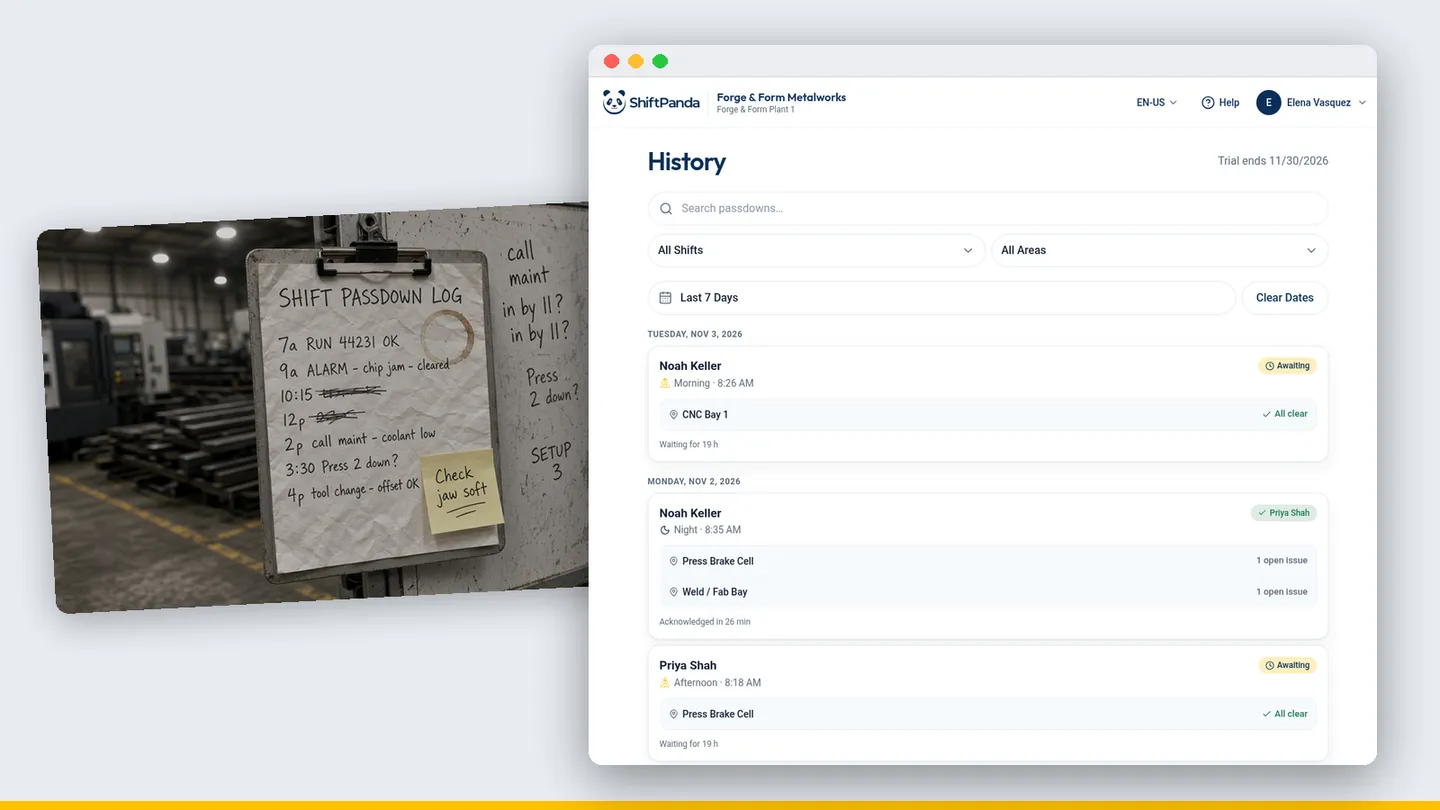
It's 6:02 AM. The incoming supervisor stands in front of the whiteboard and reads the shift handover: "P4 weird." "Ask Clive." A phone number with no name. A coffee ring over the bottom corner. The night supervisor is already in the car park.
Paper logbooks and whiteboards are still how a lot of plants run the shift handover. They're fast, everyone knows how to use them, and they never need a password. But what's quick for the outgoing shift is often slow, and risky, for the incoming one.
Why paper and whiteboard handovers stick around
Let's be fair to them. A whiteboard is right there on the floor. A binder doesn't need Wi-Fi or a charger. Nobody needs training to write "Line 2 slow" with a marker. For a lot of crews, it's simply how it's always been done, and it mostly works.
"Mostly" is the problem. The weak spots of a paper shift handover show up exactly when the incoming shift needs answers fastest.
The risks of paper and whiteboard shift handovers
Notes only the writer can read. At the end of a long shift, a handover shrinks to four words and shorthand. Handwriting gets rushed. The incoming lead spends the first ten minutes decoding instead of running the floor.
One swipe and it's gone. A whiteboard has no history. Wipe it for the next shift, or brush against it with a sleeve, and last night's handover no longer exists.
Lines get skipped. A blank page doesn't remind you about Press 4. Whatever the supervisor forgets to write simply isn't there, and the next shift has no way to know something is missing.
No proof it was read. A sign-off line on a paper log can be initialled without anyone reading the page, or skipped entirely. When something goes wrong, "I never got that" is hard to settle.
It only lives in one place. The binder sits on one desk and the whiteboard hangs on one wall. Anyone who isn't standing in front of it, such as a manager, maintenance or the next shift arriving early, has to walk over or text someone for a photo.
Pages go missing. Binders get borrowed, pages tear, and coffee happens. When the page is gone, the handover is gone.
The hidden costs of a paper handover
The risks above are the obvious ones. These cost you time every single week:
- Looking things up. "What happened on nights on Tuesday?" means flipping through a binder or hoping someone took a photo of the whiteboard.
- Tribal knowledge. "Ask Clive" works until Clive is on holiday. Paper handovers lean on whoever remembers the context, and that knowledge walks out of the door at shift change.
- Double work. In some plants, someone retypes the paper log into a spreadsheet or an email later. That's the same handover written twice.
- A slow start for new supervisors. Every plant's shorthand is different. A new lead has to learn yours the hard way, one cryptic note at a time.
Whatever your plant calls it, the next shift needs the same thing: a clear, complete picture of every machine that they know is current.
What changes with a digital shift handover
ShiftPanda does one thing: shift handovers. It keeps what's good about paper, being quick and on the floor, and fixes the rest:
- Written at the machine. It runs in the browser on a phone or tablet, with nothing to install, so the handover gets written where the shift happens.
- Every machine, every time. Set up your areas and machines once, and every handover follows them, so no line gets skipped.
- Short and clear. Set each machine to Running or Idle and add a note where it matters. It's about a minute for a simple handover, under two for a full one.
- Nothing gets wiped. Every handover is saved in History, so last Tuesday is still there, and you can search it by shift, area and date.
- Know it was read. Every handover shows who has read it and who acknowledged it, by name.
- Mid-shift issues ride along. Log an issue during the shift by area and machine, and it goes on the Open Issues list and carries over onto the next handover, instead of living on a sticky note.
- Wi-Fi drops are fine. Lose Wi-Fi mid-handover and what you've typed is still there when you're back.
If your crew likes the whiteboard for the morning huddle, keep it. The handover just shouldn't depend on it.
Try a digital handover with one crew first
You don't need a plant-wide rollout to find out if it works.
- Pick one area and set up its machines.
- Run it with your crew for a couple of weeks, alongside the binder or whiteboard if you want a safety net.
- Ask the incoming leads which handover they'd rather start the shift with.
- Bring the results to your plant manager, with real handovers from your own floor.
Be ready for the next shift tonight.
ShiftPanda turns the end of a shift into a two-minute handover your next crew actually reads.
30 days free · $9 per user per month after