The Future of Shift Management: After the Schedule Comes the Passdown
A schedule puts the right supervisor on the floor at 6:00. The shift passdown tells them what they're walking into. Where shift management goes next.
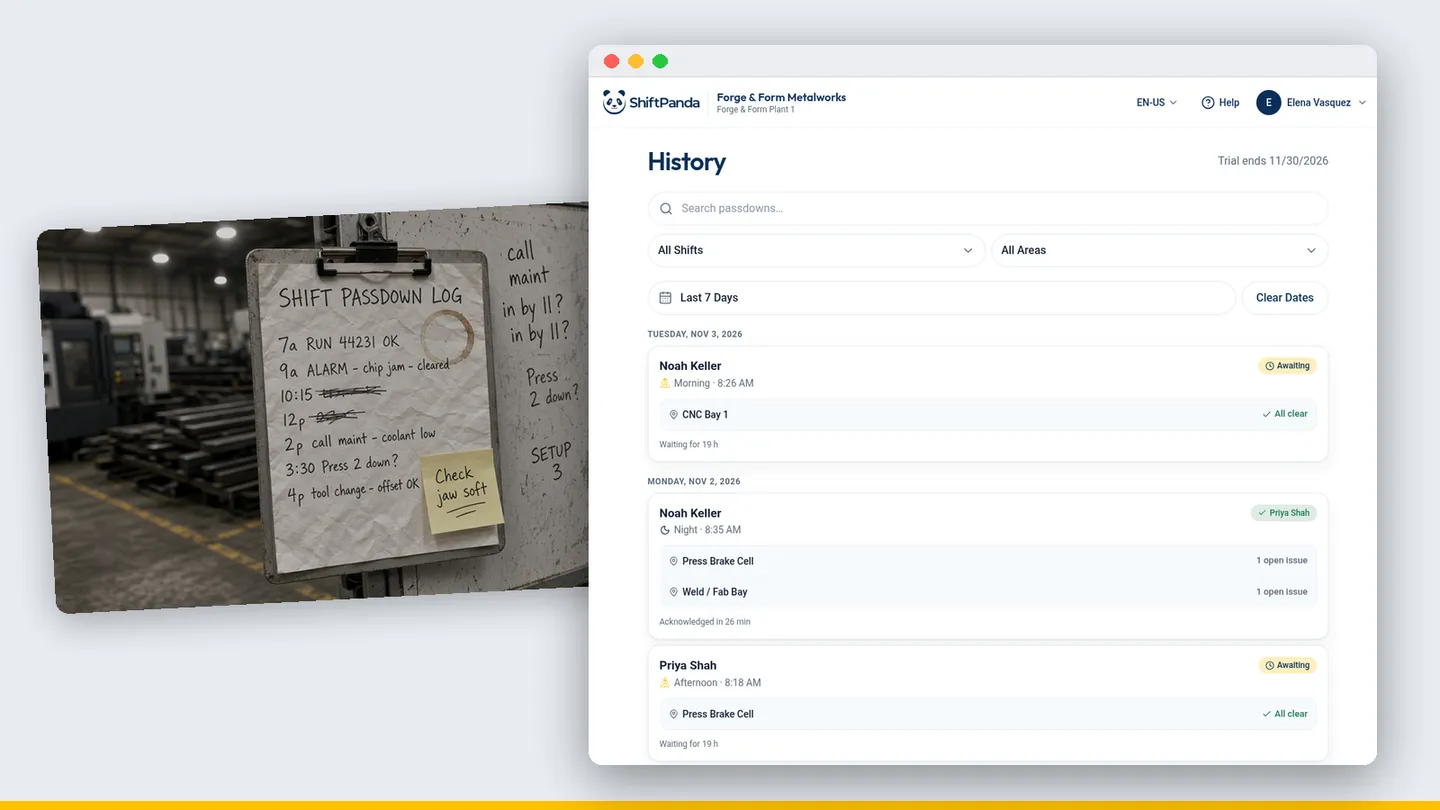
Most talk about the future of shift management is about the schedule: who works which shift, who covers a call-in, how fast the gaps get filled. That matters. But the schedule only decides who shows up. The part of shift management still running on clipboards, whiteboards and group texts is what passes from one shift to the next: the shift passdown (some plants call it a shift handover). A schedule can put the right supervisor on the floor at 6:00. It can't tell them what they're walking into.
Scheduling decides who shows up. The passdown decides what they know.
Every shift change asks two questions. Who's here? And what's going on?
The first question has had plenty of attention. Many plants already use scheduling software for coverage, time off and call-ins, and it does a real job. ShiftPanda isn't scheduling software and doesn't try to be. It sits next to whatever runs your schedule, the same way it sits alongside your MES and your maintenance system.
The second question is the one that often still lives on the back of a printout.
6:30 AM: A call-in, and the passdown that covers for it
Imagine a plant running three shifts. At 6:30 AM, Merle, the day supervisor, calls in sick. The 8:00 shift still starts at 8:00.
The scheduling side goes the way it should. Coverage gets sorted, and Rhonda, who usually runs seconds, comes in early. She knows the plant. She just hasn't run days in a month.
At 7:40 she's at the door with a coffee and one question: what happened since yesterday afternoon?
The schedule can't answer that. It knows Rhonda is on days. It doesn't know HMC 3 has been Idle since 2 AM, that Lathe 2 is halfway through a shaft order, or that nights has been nursing the press brake along with a trick nobody wrote on the whiteboard.
On a paper floor, Rhonda would piece it together from the whiteboard, from Odell, the night supervisor, if she catches him before he leaves, and from a text to Merle, who is sick and would rather not.
With the passdown in ShiftPanda, she opens it on her phone. Odell wrote it area by area, machine by machine:
Machining, HMC 3: Idle. Spindle alarm at 2 AM. Photo of the alarm screen attached. Maintenance knows. Machining, Lathe 2: Running. 60 left on the shaft order. Program's loaded. Fab, Press Brake 1: Running. Back gauge sticks on the left. Tap it and it seats. Open issue.
The press brake issue was logged two days ago. It's still on the passdown because nobody has marked it done, so nobody had to remember to write it again.
Rhonda acknowledges the passdown, and her name shows on it. Odell can see she's read it before he heads home. Merle gets to stay in bed.
Rhonda didn't start cold. She started where nights left off.
Why the passdown is the part of shift management still on paper
A schedule gets built ahead of time, at a desk, by a few people who can take their time. A passdown gets written at the end of a long shift, standing up, by whoever is running the floor. That's a harder place for software to earn its keep, so the logbook, the whiteboard and the group text have hung on.
They also hang on because they're fast. The cost shows up on the next shift: a whiteboard note that made perfect sense at 5:45 AM, a logbook page with a coffee ring where the important line used to be, a text thread nobody on days was in. There's more on that in the risks of paper and whiteboard passdowns.
The other systems on the floor don't fill the gap either. The MES knows what ran. The maintenance system knows which work orders are open. Neither one knows that the back gauge sticks on the left and you tap it.
What a shift passdown needs to do on any shift
The call-in is just the sharp version of an everyday problem. Every shift change has someone walking in who wasn't there for the last eight hours. A good passdown works the same for them whether they run that shift every day or got the call at 6:30:
- Area by area, machine by machine, in the same order every shift, with each machine Running or Idle.
- Notes, photos and attachments, so "leaking a little" comes with a picture of how little.
- Open issues that carry over onto the next passdown until someone marks them done.
- Who read it and who acknowledged it, by name, so "I never got that" gets settled fast.
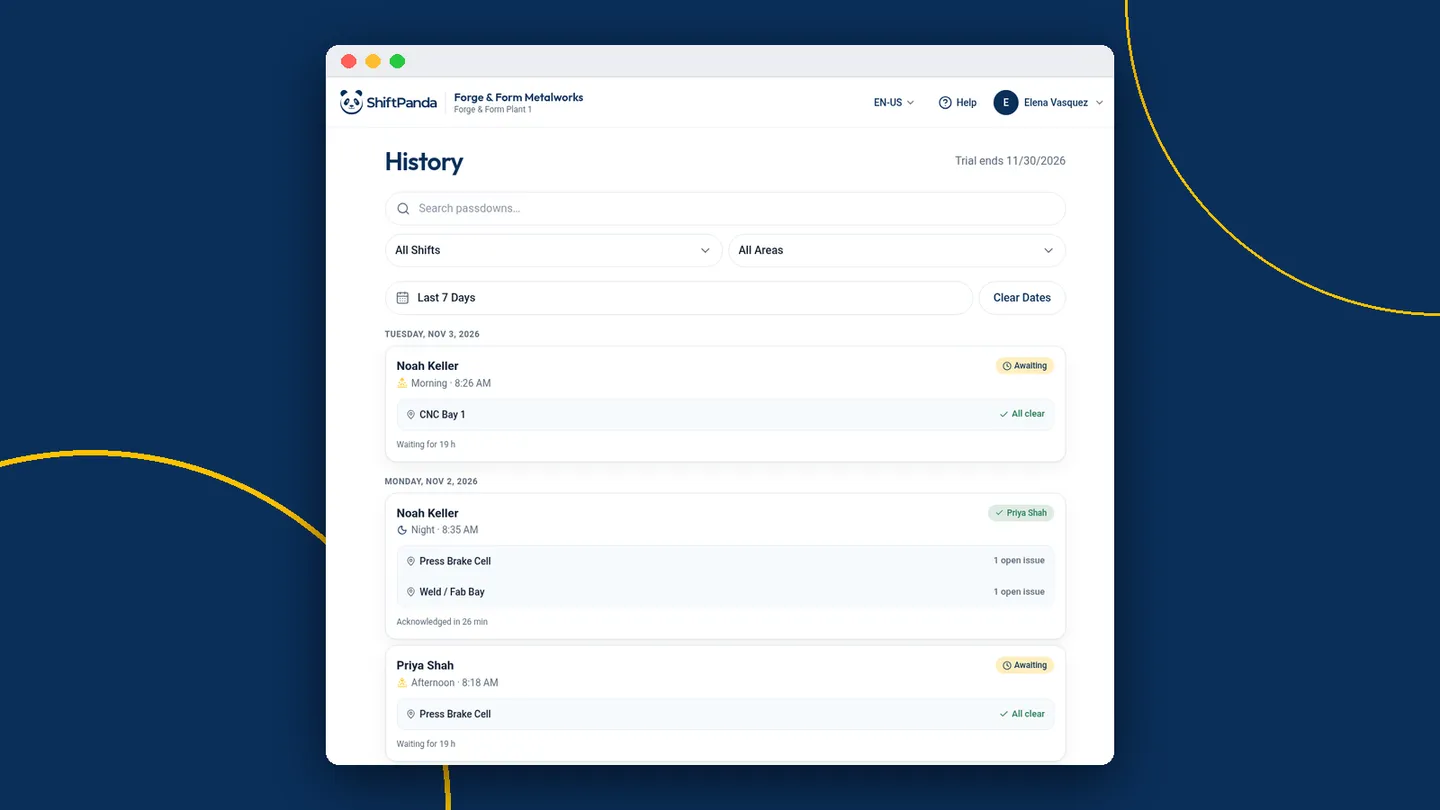
- History you can search by shift, area and date, for when someone asks about nights last Tuesday.
- Runs in the browser on a phone or tablet. Nothing to install, and what you typed is still there if the Wi-Fi drops.
A simple passdown takes about a minute. A full one takes under two. If you want to check what goes into yours, here's a shift passdown checklist.
Where shift management goes from the passdown
None of this needs a crystal ball. It's mostly the passdown catching up with the schedule.
The schedule and the passdown sit side by side. One says who's on. The other says what they're walking into. Once the first one is sorted, the second one is where the first ten minutes of a shift actually go.
What gets written today is there tomorrow. A whiteboard gets wiped. A passdown in History can still be found next month by shift, area and date.
The plant manager reads it before the meeting. When every area's passdown is in one place, the 8:00 meeting can start with decisions instead of "so, what happened overnight?" That's covered in how plant managers use the shift passdown.
Machine issues add up to something. An Admin can export Machine Issue Reports to CSV, Excel or PDF, so a month of issues can sit on one sheet for a review with maintenance.
People still talk at shift change. Nobody is automating the walk to the press brake to look at the back gauge. The passdown makes that conversation shorter and more useful. It doesn't replace it.
Start the passdown with one crew
You don't need a rollout plan. You need one supervisor and one crew.
- Set up your areas and machines once. You know the floor better than anyone.
- Run the passdown in ShiftPanda for a couple of weeks with your crew, alongside what you already do if that helps.
- Bring the results to your plant manager. Open History and the Open Issues list together and decide whether it's worth keeping.
The schedule will keep telling people when to show up. The passdown is how they know what to do once they're there, even on the morning the schedule had to scramble.
Be ready for the next shift tonight.
ShiftPanda turns the end of a shift into a two-minute handover your next crew actually reads.
30 days free · $9 per user per month after